
Revised water policy directives and TFA
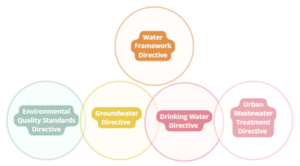
This news item summarises the revised water policy directives and the drinking water directive as they relate to Trifluoroacetic acid (TFA). The Drinking Water Directive 2020/2184 includes TFA in ‘PFAS Total’. The Environmental Quality Standards Directive for Surface Waters (2008/105/EC) includes TFA in the PFAS group but also defines Relative Potency Factor (RPFs) compared to PFOA. The RPF for Trifluoroacetic acid (TFA) is RPF 0.002.
The European Union has adopted a major update to its water policy framework, agreed on 30 March 2026 by the Council and Parliament of the draft EU directive proposing amendments to three key water policy directives: the Water Framework Directive (2000/60/EC), the Groundwater Protection Directive (2006/118/EC), and the Environmental Quality Standards Directive for Surface Waters (2008/105/EC). The EU-wide list of these substances has now been expanded and updated, including pharmaceuticals (such as painkillers), pesticides, bisphenols, and per- and polyfluoroalkyl substances (PFAS, including TFA). For the first time, the directive introduces rules to assess the cumulative risk of combined substances. Several pollutants that are already on the list will now be subject to tighter environmental quality standards. To support future reviews, the directive also adds microplastics and antimicrobial resistance indicators to the EU’s water watchlists, which help track substances of emerging concern. EU countries will have until 2039 to comply with the new standards for both surface water and groundwater. This deadline applies to PFAS with the possibility of a 6 year extension. For substances with revised and more stringent environmental quality standards in surface water, the compliance deadline is 2033.
Drinking Water Directive 2020/2184. Under new rules, which applied from 12 January 2026, Member States must monitor, in a harmonised way, per- and polyfluoroalkyl substances (PFAS) levels in drinking water to ensure compliance with the new EU limit values under the recast Drinking Water Directive.
The requirements for TFA under these directives are summarised in the table below, noting that Sum of 24 PFAS for Groundwater corresponds to the sum of PFAS in the DWD (list of substances is mentioned in the DWD but also adds TFA), and these 24 are not the same 24 in the sum of PFAS for surface water. The analytical reporting of ‘PFAS Total’ and TFA are also reproduced below from the Commission technical guidelines.
| Parameter | |
| Drinking water directive
This contributes directly to a key objective of the Water Resilience Strategy – the right to safe drinking water. Member States to decide to use either one or both of the parameters Member States must monitor PFAS levels in drinking water and inform the European Commission of their results. |
‘PFAS Total’ means the totality of per- and polyfluoroalkyl substances. 0.5µg/l
Includes TFA |
| ‘Sum of PFAS’ means the sum of a subset of per- and polyfluoroalkyl substances considered a concern as regards water intended for human consumption listed in point 3 of Part B of Annex III. 0.1 µg/l. This is a subset of ‘PFAS Total’ substances.
This subset of substances of concern does not include TFA |
|
| Directive 2006/118/EC Ground water
|
Environmental Quality Standards (EQSs) for Ground water:
Sum of 20 PFAS = 0.1 µg/L (in line with DWD). This subset of substances of concern does not include TFA Sum of 4 PFAS* = 0.0044 µg/L (PFHxS, PFOS, PFOA, PFNA) |
| Directive 2008/105/EC Surface waters
|
Annex I to Directive 2008/105/EC is amended as follows:
(1) the title is replaced by the following: Environmental Quality Standards (EQS) for Priority Substances in Surface Waters. Includes TFA (explained below) |
| Directive 2008/105/EC Surface waters
& Directive 2006/118/EC Ground water
|
At the next reviews of these directives. The Commission shall consider establishing quality standards for PFAS Total and aim to complement the guidance on monitoring PFAS Total in drinking water. Member States are encouraged to already apply that guidance to monitor PFAS Total in groundwater and to report the data.
Considering the toxicity, persistence and prevalence of trifluoroacetic acid (TFA) in the environment, the Commission shall, at the next reviews, also consider establishing a quality standard for TFA separately, or as a part of a sum, in Annex I to this Directive. |
Commission Notice: Technical guidelines regarding methods of analysis for monitoring of per- and polyfluoroalkyl substances (PFAS) in water intended for human consumption (C/2024/4910)
Analytical reporting of ‘PFAS Total’
For the analytical reporting of the results of ‘PFAS Total’, the contribution of the ultrashort-chain PFAS TFA in water intended for human consumption should be evaluated, as the TFA concentration could (significantly) exceed the DWD parametric value of ‘PFAS Total’.
| The Commission recommends the following approach for reporting analytical results of ‘PFAS Total’:Step 1: | Determine the analytical result for ‘PFAS Total’ ([PFAS Total]) by using one of the three recommended proxy methods of analysis, indicating which method has been used ([PFAS Total TOP], [PFAS Total EOF-CIC PFOAeq] or [PFAS Total HRMS]). |
| Step 2: | Determine the analytical result for the substance TFA ([TFA]) using a targeted method of analysis. The targeted method should comply with the requirements set out in Annex III to the Directive, in particular with the requirements in Part B for the ‘PFAS Total’ parameter. |
| Step 3: | The analytical report includes the reporting of [PFAS Total], [TFA] and [PFAS Total] – [TFA], indicating which proxy method and targeted method have been used. |
| Step 4: | If [PFAS Total] – [TFA] < 0, it is recommended to mark the reported analytical results in step 3 as inconclusive. |
Environmental Quality Standards (EQS) for Priority Substances in Surface Waters
Annex I to Directive 2008/105/EC is amended as follows:
For the group of PFAS, the EQS refer to the sum of the concentrations of the 25 PFAS listed expressed as PFOA-equivalents based on the potencies of the substances relative to that of PFOA, i.e. the Relative Potency Factor (RPFs). The RPF for Trifluoroacetic acid (TFA) is RPF 0.002.
Explanatory note for TFA RPF: This is based on the RIVM report (2023) Drinkwaterrichtwaarde voor trifluorazijnzuur Advies 14434A02 TFA Bilthoven, NL, which determined an indicative limit for TFA of 2200 ng/l for drinking water.
Per- and polyfluoroalkyl substances (PFAS) – sum of 25 including TFA
| AA-EQS Inland surface waters [μg/l] | AA-EQS Other surface waters [μg/l] | EQS Biota [μg/kg wet weight]
or EQS Sediment [μg /kg dry weight] where so indicated |
|
| Sum of PFOA equivalents 0.0044 | Sum of PFOA equivalents 0.0044 | Sum of PFOA equivalents 0.077 | |
Relevant footnotes for PFAS sum of 25
AA-EQS: This parameter is the EQS expressed as an annual average value (AA-EQS). Unless otherwise specified, it applies to the total concentration of all substances and isomers.
Inland surface waters encompass rivers and lakes and related artificial or heavily modified water bodies.
If an EQS for biota or sediment is given, it, rather than the water EQS, shall be applied, without prejudice to Article 3(3) of this Directive allowing an alternative biota taxon, or another matrix, to be monitored instead, as long as the EQS applied provides an equivalent level of protection. Unless otherwise specified, it applies to the total concentration of all substances and isomers. Unless otherwise indicated, the biota EQS relate to fish. “fw fish” indicates the biota EQS for freshwater fish monitored in inland waters; “sw fish” indicates the biota EQS for saltwater fish monitored in other surface waters.
For the group of PFAS the EQS refer to the sum of the concentrations of the 25 PFAS expressed as PFOA-equivalents based on the potencies of the substances relative to that of PFOA, i.e. the RPFs. The critical EQS is the biota EQS (relating to fish consumption) and must therefore be complied with. The AA-EQS are not equivalently protective.
The minimum performance criteria laid down in Directive 2009/90/EC apply to each individual substance within the group of substances but taking account of the need to quantify the contribution of each substance to the total concentration for comparison with the EQS.
Directive 2009/90/EC lays down technical specifications for chemical analysis and monitoring of water status in accordance with Article 8(3) of Directive 2000/60/EC. It establishes minimum performance criteria for methods of analysis to be applied by Member States when monitoring water status, sediment and biota, as well as rules for demonstrating the quality of analytical results.
For more information
Drinking water directive.
Water policy directives.