
How to recognise illegal HFCs

To prevent illegal refrigerants from entering our economy, it is important to know the risks and how to recognise illegal products.
Raising awareness and spreading this information within your company, with your commercial partners and across the value chain is crucial.
Refrigerant Cylinders
- Watch out for disposables: they are banned for sale in Europe!
- Disposable cylinders have been banned in Europe since 2007. Cylinders MUST be able to be returned to the supplier.
- They do not comply with ADR Transport Regulations for dangerous goods.
- They can contain chemical substances which are not registered under the EU REACH regulation.
- Refillable cylinders need to fulfil certain criteria: they need to comply with the Transportable Pressure Equipment Directive (TPED)
- They need to be pressure-tested regularly and stamped accordingly – including the date of the next test
- The valves need to be stamped with the homologation number

Cylinders need to bear the following stamps and information:
- Labelled with the Pi (л) stamp
- EN 13322-1: compliance with standard of design and construction
- TPED approval
- Year and month of production
- Cylinders need to be maintained/inspected after10 years. The year of end of service must be marked on the cylinder
Documentation and safety data sheet (SDS)
Any refrigerant delivery needs to be accompanied by the relevant Safety Data Sheet (SDS) issued by the gas producer/or supplier. Besides many other criteria, the SDS needs to contain the following mandatory information:
- Issued by the gas producer in your national language
- Clear indication of product trade name
- Clear indication of CAS number
- Clear indication of CE registration
- Clear indication of the producer including address and emergency number
- Clear indication of the REACH registration number for each component, which can be double-checked on the ECHA website. Important: blends have several components, therefore several REACH registration numbers are required
- Clear indication of the hazard identification/classification according to the CLP Regulation (EC) 1272/2008 including hazard pictogram
Labelling
All refrigerant cylinders need to be clearly labelled:
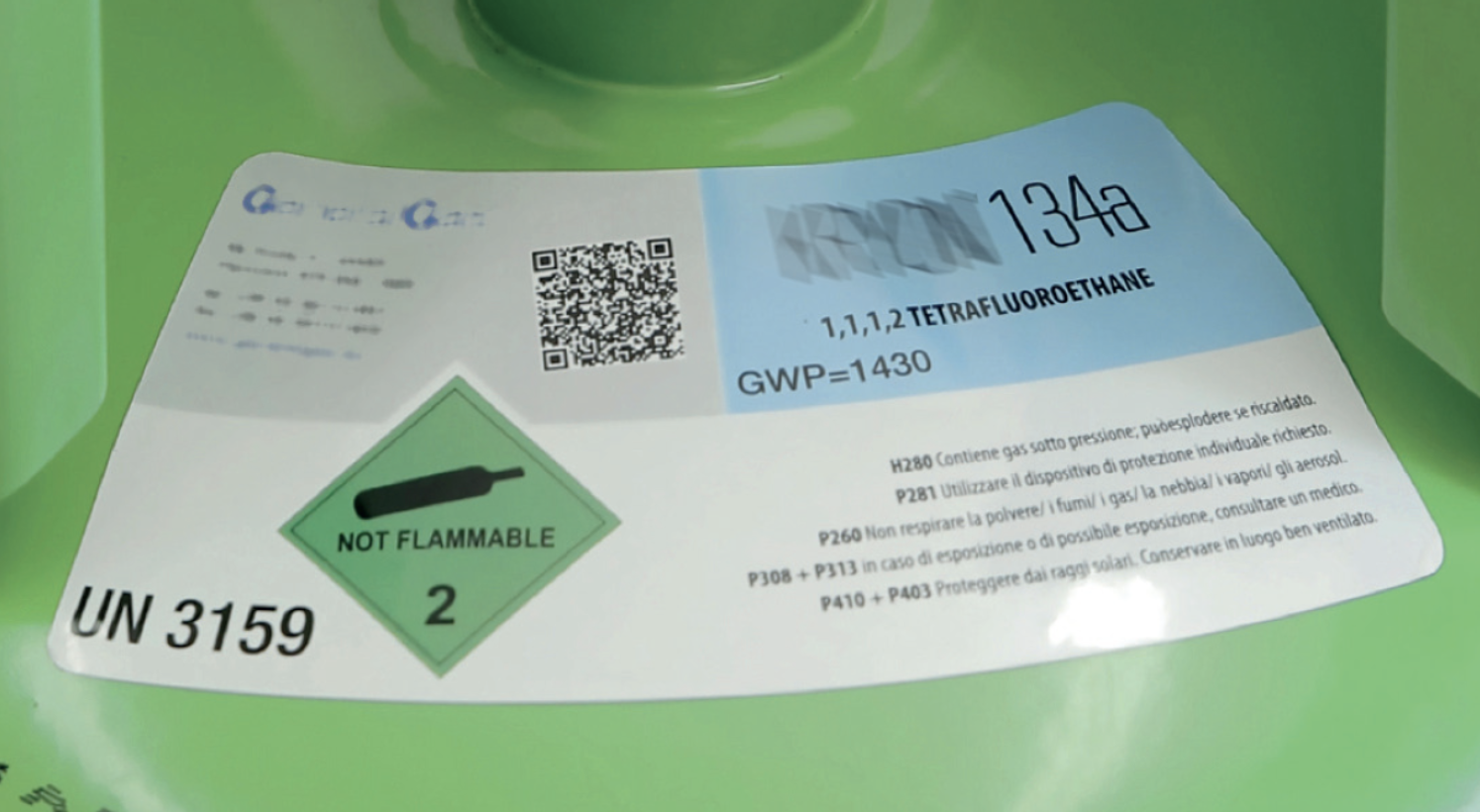
- Clear indication of the supplier
- Safety indication in your national language
- ADR Transport Symbol and UN number
- Hazard pictogram acc. To (CLP) Regulation 1272/2008 (both on bottle and on SDS)
- Hazard statements (e.g. H280 = contains gas under pressure, may explode if heated)
- GWP (Global Warming Potential)
- Contains fluorinated greenhouse gases according to Implementing Regulation (EU) 2024/2174
- Quantity in grams or kilograms and in tonnes CO2 equivalent acc. to EU F-gas Regulation Article 12 and Implementing Regulation (EU) 2024/2174
Reporting illegal trade of refrigerants
In case you are confronted with illegal refrigerants or suspicious activities, we encourage you to report this. This can be done by:
What are the risks of purchasing illegal refrigerants?
- Financial impacts: high fines, or even criminal prosecution
- Operational impact: and performance of equipment if refrigerants do not comply with specifications ((impurities, contamination with oil and other substances, etc.) leading to loss of capacity, reduced energy efficiency, higher operational costs, equipment failures .
- Business impact: Deterioration of relationship with customers or even loss of customers due to problems with the equipment and risk of closing businesses. Reputational damage.
- Health and safety impact: Refrigerants fall under “dangerous substances” and need to be handled with care, even more so with the increased use of flammable and high-pressure gases. Refrigerants that do not comply with the gas producers’ specifications or with the content indicated on the cylinders can pose a serious risk for the health and safety of installers and users.
- Environmental impact: Illegal trade undermines the F-Gas Regulation‘s aim to phase down HFCs. Risks such as refrigerant leakage into the atmosphere increase even further with the use of inadequate cylinders, or illegal disposable cylinders.
- Impact on crime: the illicit trade in refrigerants is more and more undertaken by large and well organised criminal networks. Such criminal organisations are seldom involved in only one product. Buying illegal refrigerants funnels your legitimate earnings into the hands of criminal organisations, causing wider societal harm.