Illegal Imports of F-gases Round-up
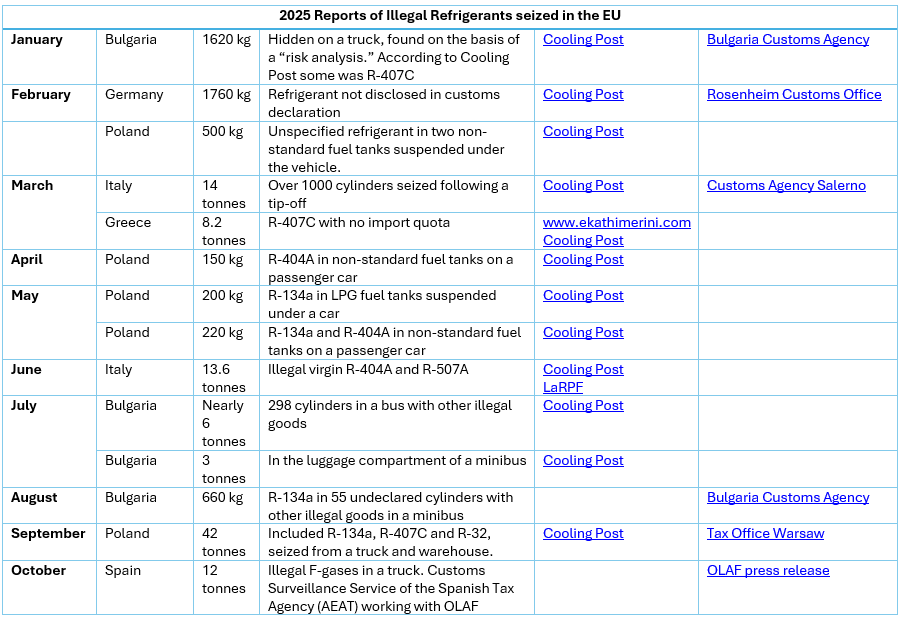
In this round-up: F-gas Regulation 2024/573 has specific measures to help combat illegal trade in HFCs to help maintain the integrity of the phase-down and specific use bans. In 2025, since the previous illegal trade round-up, customs authorities have intercepted illegal imports of HFCs. There are reports of deliberate mislabelling of virgin R-404A 7 R-507 as recycled (Cooling Post), or as compliant lower GWP refrigerants (Cooling Post). The illegal imports summarised in the table have links to detailed reports and cover over 100 tonnes of illegal refrigerants intercepted with several different import methods detected. Customs agency reports are available for some of the seizures, and Cooling Post is excellent at reporting the illegal trade. In the EU, use the anonymous European Anti-Fraud Office (OLAF) Fraud Notification System to report illicit HFC activity, see Home - Fluorocarbons and https://fns.olaf.europa.eu/.
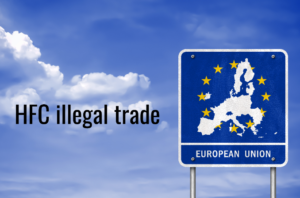
Anybody with information on illegal trade can provide information to OLAF. Quantities of refrigerant were seized in Moldovia, with the support of the European Anti-Fraud Office (OLAF) and the EU Border Assistance Mission to Moldova and Ukraine (EUBAM) (Cooling Post) and intercepted in Serbia in a bus heading for Germany (Cooling Post). For 2024, the responsible authority in Italy, Customs and Monopolies Agency, reported that it seized 500 tonnes of illegal refrigerants (LaRPF & Cooling Post).
Hydrofluorocarbons (HFCs) have long been essential to refrigeration, air conditioning, and specialty applications. But while regulations like the EU F-gas Regulation and the Kigali Amendment aim to phase down high-GWP HFCs, illegal trade continues to undermine these efforts.
The illegal HFC market is more than a compliance issue, it is a climate challenge. Illegally imported HFCs often bypass quotas, safety standards, and documentation requirements, meaning they contribute to greenhouse gas emissions without oversight. Beyond environmental impact, improper handling can pose serious safety risks, from toxic exposure to flammability hazards.
We have a dedicated page on our website which dives into the mechanisms of illicit trade, from mis-declared shipments to cross-border smuggling. It highlights the real-world consequences: delayed adoption of low-GWP alternatives, market distortion, and additional burden on law enforcement and regulatory agencies.
Education, vigilance, and collaboration are key. The more the industry understands the pathways and consequences of illicit trade, the better equipped we are to close loopholes and accelerate the transition to sustainable refrigerants.
Discover the science and regulation behind illegal HFCs: https://www.fluorocarbons.org/illegal-hfcs/about-illegal-hfcs/